KEEP IN TOUCH
(07) 3105 7800
Turrbal and Jagera Country
Level 4, 348 Edward Street
Brisbane QLD 4000
(07) 3105 7800
Turrbal and Jagera Country
Level 4, 348 Edward Street
Brisbane QLD 4000
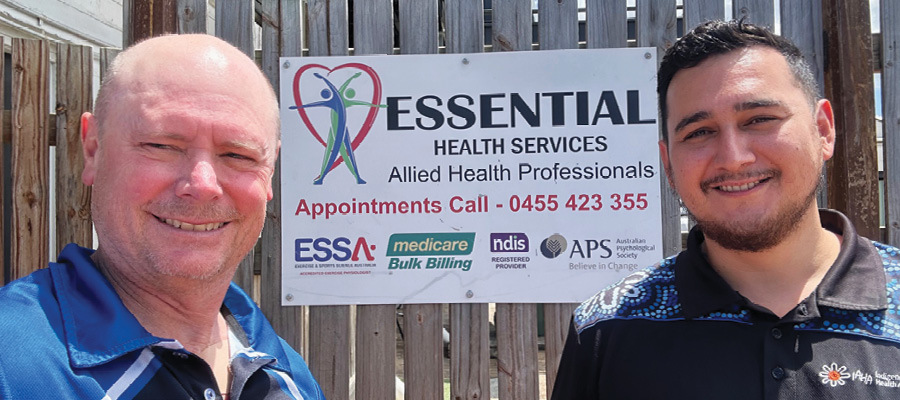
"Collaboration and simple conversations can lead to meaningful benefits for the whole community."
Geoff French, Practice Manager, Essential Health Services
In rural healthcare, meaningful outcomes are often created through connection rather than coincidence. In the South Burnett, a collaboration between Health Workforce Queensland (HWQ) and Essential Health Services has led to expanded allied health services and a stronger local workforce, demonstrating how open conversations can translate into real community benefit.
Essential Health Services in Nanango and Kingaroy, led by Practice Manager Geoff French, plays a vital role in improving access to allied health care in a region where services are often limited or unavailable. The practice provides locally based, community-focused care that supports people across the lifespan, particularly those who would otherwise need to travel long distances to access essential services.
“Our focus is on early intervention, functional independence, and continuity of care,” Geoff explains. “We work closely with families, GPs, schools, NDIS providers, and community organisations to ensure people can receive the right support, at the right time, close to home.”
Rather than focusing solely on existing service models, Essential Health Services takes a collaborative approach to identifying gaps and exploring new opportunities. For Geoff, collaboration is not simply a strategy, it is essential to sustaining healthcare in a regional setting.
“Collaboration is essential in regional workforce development because no single organisation can solve workforce shortages alone,” he says. “By working with training providers, workforce agencies and health professionals, we can create opportunities that benefit both practitioners and the community.”
He adds that this approach allows the practice to think creatively about placements, supervision, flexible work models and scope of practice, while ensuring clinicians feel supported, valued and connected rather than isolated in a rural setting.
One conversation that sparked tangible change occurred at the IAHA Conference late last year, where Health Workforce Queensland hosted a trade booth focused on supporting health professionals interested in remote and rural practice. It was here that HWQ’s Regional Coordinator, Marijana Duljaj, met Markas Jacobsen, an osteopath considering relocating to Kingaroy.
For Markas, the conversation proved pivotal.
“Prior to that discussion, regional practice was more of a general goal rather than a concrete plan,” he says. “Marijana asked what my goals were, and the conversation helped clarify what opportunities actually existed, what regions were in need, and how realistic the transition would be.”
What had felt uncertain suddenly became structured and achievable.
“Health Workforce Queensland reframed regional work from something that felt uncertain into something that felt well supported,” Markas explains. “They facilitated connections, provided practical information about working and living in a regional area, and helped bridge the gap between interest and action.”
Following the conference, Marijana confirmed Markas’ intention to relocate and recognised a potential service gap in the South Burnett. She contacted Geoff to explore whether osteopathy services were currently available in the region. They weren’t.
Rather than seeing this as a constraint, Geoff saw opportunity.
Health Workforce Queensland’s understanding of regional workforce challenges, combined with its ability to connect practices with emerging clinicians, proved instrumental.
“HWQ supported us to look beyond traditional recruitment pathways and consider placements and early-career opportunities as part of a longer-term workforce strategy,” Geoff says. “That has been invaluable in a region like the South Burnett.”
After meeting with Markas to explore how osteopathy could complement existing services, a new chapter began. Markas commenced with Essential Health Services in February, introducing osteopathy services to the region for the first time.
For Essential Health Services, the addition of osteopathy strengthens its integrated, interprofessional model of care.
“Osteopathy fits very naturally within our broader service offering,” Geoff says. “It complements our existing allied health services by addressing musculoskeletal, functional and pain-related presentations that impact people’s ability to work, stay active and participate in daily life.”
Having osteopathy embedded within the practice improves referral pathways and enhances coordinated, whole-person care, particularly important in a regional setting where integrated care is critical.
For Markas, the decision to relocate was both professional and personal.
“I wanted to work in a community where my skills as an osteopath could have a meaningful and tangible impact,” he says. “In rural areas, access to allied health services can be limited, particularly for acute and chronic musculoskeletal conditions.”
Beyond professional opportunity, the lifestyle and sense of connection also played a role.
“The sense of community and the opportunity to establish long-term patient relationships in Kingaroy and the wider South Burnett strongly appealed to me,” Markas explains. “Rural practice offers a level of professional fulfilment and connection that is often harder to achieve in metropolitan settings.”
“Rural practice offers a level of professional fulfilment and connection that is often harder to achieve in metropolitan settings.”
Markas Jacobsen, Osteopath, Essential Health Services
For Geoff, the value of an organisation like Health Workforce Queensland acting as a connector cannot be overstated.
“For many health professionals, regional practice can feel like an unknown,” he says. “HWQ helps bridge that gap by connecting practitioners with supportive practices, providing accurate information about regional opportunities, and reducing the uncertainty that can deter people from going rural.”
For practices, this means more than filling vacancies. It means matching genuine community need with motivated clinicians and supporting sustainable workforce pathways rather than short-term fixes.
Markas agrees.
“I would strongly encourage anyone to have the conversation,” he says of approaching a HWQ booth. “Even if you’re unsure about regional practice or don’t have a clear plan, they can help you understand what options exist and what support is available. That single conversation can genuinely change the direction of your career.”
While expanding services is a significant achievement, sustaining a strong, capable workforce remains the long-term priority. With HWQ’s support, Essential Health Services continues to build a well-rounded team across multiple health professions, strengthening both diversity and capacity to deliver culturally responsive, community-centred care.
Looking ahead, the focus is on sustainability.
“A key goal for us is building a workforce for the future, not just meeting immediate service demand,” Geoff says. “We aim to offer student placements so emerging allied health professionals can experience country practice firsthand.”
By exposing placement students to the benefits of regional work, strong professional support, meaningful client relationships and lifestyle balance, Essential Health Services hopes to help develop, grow and retain the allied health workforce in rural Queensland.
For Geoff, the experience reinforces a simple but powerful lesson.
“The incredible support Health Workforce Queensland has provided has genuinely made a significant difference to the services across our region,” he says. “It all started with a conversation.”
If you are interested in discovering a dream role in rural Queensland reach out to our Health Workforce Solutions recruitment team here. You can view all current roles via the button below.

(07) 3105 7800
Turrbal and Jagera Country | Level 4, 348 Edward Street
Brisbane QLD 4000 / GPO Box 2523, Brisbane QLD 4001
HWQ operates a flexible hybrid work environment. Should you wish to meet with a staff member in person, please schedule an appointment.